About
It started in a hospital parking garage.
kid.studio is a small studio in Santa Cruz, California, building screen-free things for kids. Robi is the first. It exists because of one bad morning and a question that would not go away: who is actually in charge of the thing a family already paid for?
The first question
We had paid for the story. Why couldn't we play it?
Our two-year-old was about to go into surgery. His mother, eight months pregnant, had bought him a new Tonie figure to help him feel brave. We set it on the Toniebox in the parking garage and got: "Uh-oh! The download has stopped too soon. Please check if I'm still connected to the internet." Fifteen minutes on a hotspot, then on the hospital WiFi. Nothing. The figure sat there, paid for and useless, right when we needed it most.
He was strong about it; he did not know what he was missing. We did. We owned the player and we owned the story, and the one thing we had brought to comfort him would not work because it had to phone home to a server first.
It was not the only frustration, just the sharpest. Every kids' player we looked at felt like a trap: fifteen dollars for a single story, a locked ecosystem, no way to play what our family already had. That morning became a plain standard. A family should be able to choose its audio, put it on the player, and know it will be there when the internet is not.
The everyday ride
Choosing a story should not mean handing over a screen.
The real opportunity was not the hospital. It was the car, the stroller, the plane. A phone can play the right story, but it puts a screen in the child's hands. Cards and figures add another thing to carry and find, even when the story is already on the player.
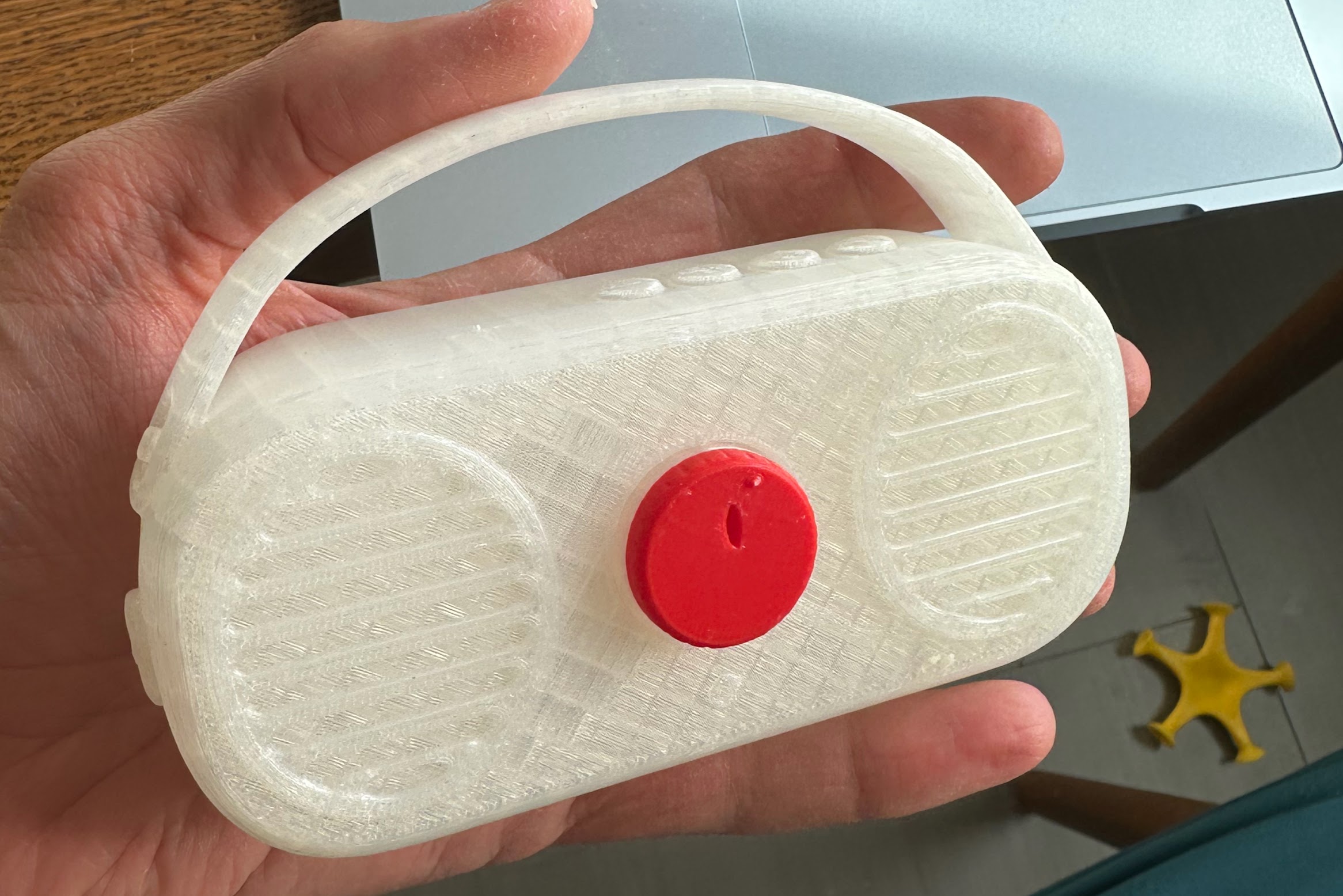
Robi is a separate thing that belongs to the child. They notice it, pick it up by the handle and start it themselves. You decide what is on it. Reading together at home keeps its own place; Robi is for the parts of the day that used to go to a screen.
The name
Named by a four-year-old, for a toy train.
At home it was "the audio device" for a long time. The first prototype was named after the boy it was built for; when his brother arrived that stopped feeling right, and for a while it was Pip.
Then his grandmother gave him a maglev set with two trains, and he named them Dot and Robi. Either one could have been the name of the audio device. Dot was already a smart speaker. Robi was fresh, sounded like a friendly robot, and was his. It stuck.
Why open
Things families rely on keep getting sold out from under them.
The toy, the food brand, the app that was good until it was bought. Families trying to raise good humans bring a lot of products into the house, and it is hard to trust any of them when the next owner can hollow one out for a quarter's numbers.
So Robi's openness is not a promise about our intentions. The files and the code publish before launch, and they open fully on a clock written into the licenses. Nobody, including us or whoever comes after us, can quietly turn Robi into something else. The terms, layer by layer.
The standard
Four things every decision has to pass.
Calm dependability for the kid, real control for the parent, nobody selling to a child or studying one, and the work kept in the open.
It belongs to the child.
The handle, the knob, the sound and the light make Robi understandable and worth reaching for.
The parent defines the world.
Nothing gets onto Robi without a deliberate choice by a grown-up.
Our children are not products.
There are no ads and nothing to buy on Robi. No microphone, no camera, no child account. Nothing about a child is sold, used for ads, or used to train AI.
Built in the open.
The work is written up as it happens, misses included, not as a launch story later. Unfinished work is labelled unfinished. Anything that stays closed, we name, and say why.
Who makes it
kid.studio, Santa Cruz, California.
kid.studio is a brand of Kid Labs LLC. It was started by Michael Ferris, a product builder and father of two, who is responsible for getting Robi right: tested beyond his own family, manufactured in the open, and plain about what is not finished yet. Rev A boards are on the bench now and the Kickstarter opens early 2027.
Kickstarter, early 2027
Be there when Robi ships.
One email when preorders open. Build notes in between if you want them. Nothing else.
Join the waitlist